
Deterministic tools for AI agents, preventing hallucinations in math and data.
Product memo
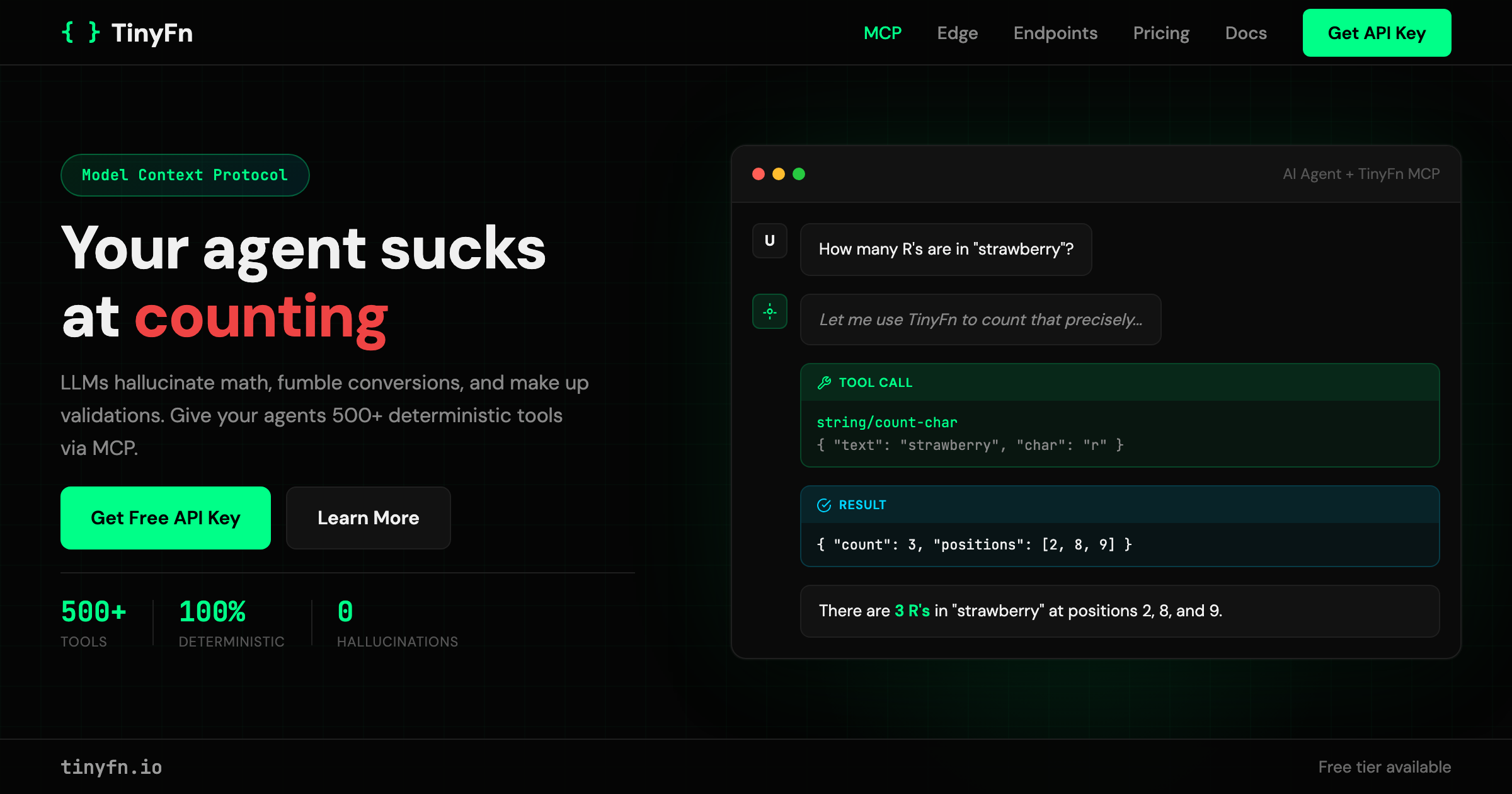
AI agents often struggle with precise math, conversions, and data validation, leading to 'hallucinations.' TinyFn equips these agents with over 500 deterministic tools via its Model Context Protocol (MCP), ensuring accurate outputs. It integrates through MCP clients, a REST API, and edge computing, providing a reliable layer for AI assistants.
For who
AI agents and developers
Solves what
AI hallucinations in math, conversions, and validations with deterministic tools.
- 500+ deterministic tools
- Model Context Protocol (MCP)
- REST API and Edge Computing options
In their own words
TinyFn - 500+ Deterministic MCP Tools for AI Agents
Model Context Protocol
Give your agents 500+ deterministic tools via MCP. Stop hallucinations on math, conversions, and validations.
Commercial cues
Model
subscription
Free tier
Yes
Trial
Available
Pricing Strategy
- • A free tier with 100 requests/month invites developers to test agent reliability.
- • An Enterprise custom plan removes limits for high-volume, production-grade deployments.
Operator context
Operating setup
Platform
API
Audience
Developers
Market demand
Tinyfn keyword demand
5 keywords
Market demand is Starter-tier market intelligence.
Derived from this product’s latest SimilarWeb keyword mix — directional demand, not proof.
Builder Strategy
- Strategy Type
- Niche Specialist
- Stage
- Pre Revenue
- Effort
- Solo Buildable
About Tinyfn Expand
TinyFn addresses a core challenge for AI agents: their tendency to 'hallucinate' or produce incorrect outputs in tasks requiring precise calculations, conversions, or data validation. It offers a suite of over 500 deterministic tools, integrated through its Model Context Protocol (MCP), a REST API, and edge computing options.
This makes it a foundational layer for developers building reliable AI assistants. By focusing on this specific problem, TinyFn carves out a niche that enhances the accuracy and trustworthiness of AI applications, moving beyond the inherent limitations of large language models.