

Product memo
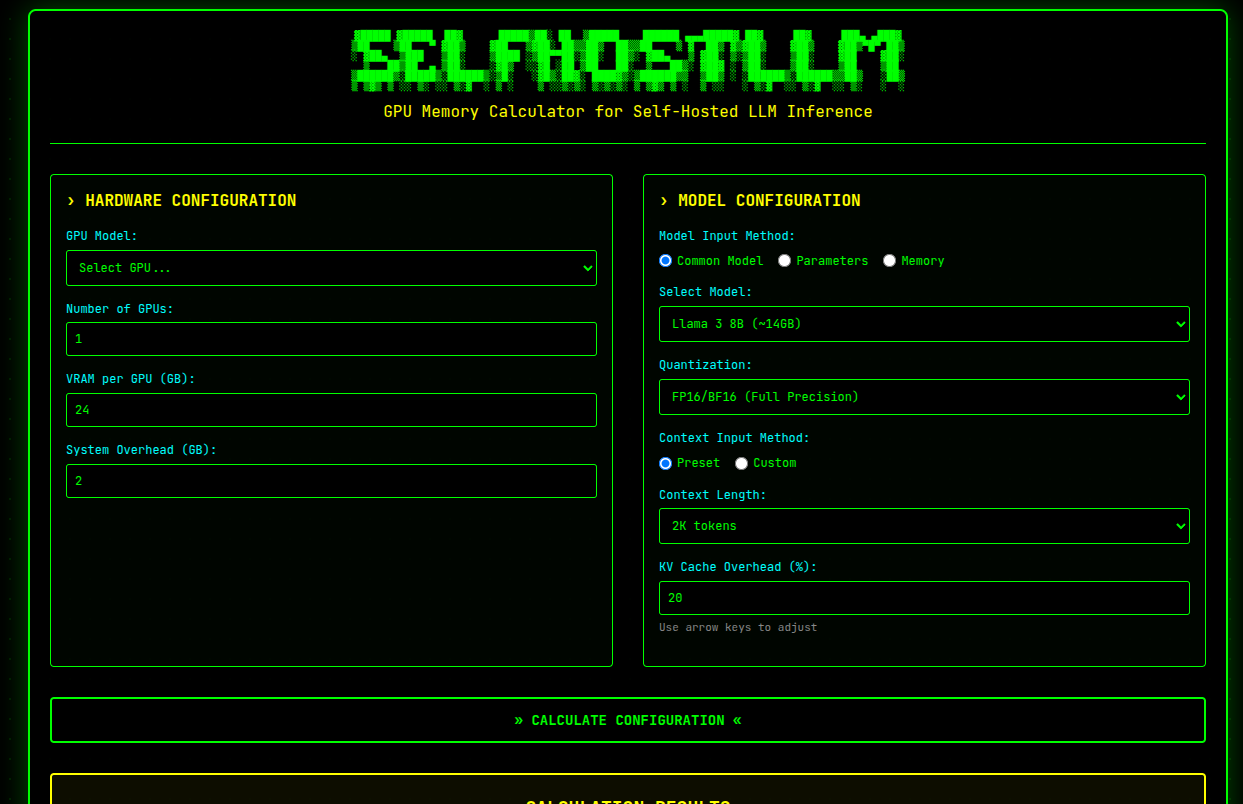
AI infrastructure planners and developers use SelfHostLLM to estimate the hardware demands of large language models. It calculates GPU memory requirements and maximum concurrent requests, accounting for model architecture, quantization, and KV cache. This helps teams efficiently provision resources for self-hosted LLM inference, including complex Mixture-of-Experts models.
For who
AI infrastructure planners and developers
Solves what
Estimates GPU memory and concurrent requests for self-hosted LLMs.
- GPU memory calculation
- Concurrent request estimation
- Performance prediction
In their own words
SelfHostLLM
GPU Memory Calculator for LLM Inference
Calculate GPU memory requirements and max concurrent requests for self-hosted LLM inference. Support for Llama, Qwen, DeepSeek, Mistral and more. Plan your AI infrastructure efficiently.
Commercial cues
Model
free only
Free tier
Yes
Trial
No
Pricing Strategy
SelfHostLLM offers a free tier; paid plan details are not publicly priced.
- • No recurring costs, focusing purely on the tool's listed feature value.
- • Free tier lowers testing friction.
Operator context
Operating setup
Team
Indie / lean
LLM classification
Founded
Aug 2025
Platform
Web app
Audience
Developers
Social footprint
Builder Strategy
- Strategy Type
- Niche Specialist
- Stage
- Bootstrapped Lean
- Effort
- Solo Buildable
About SelfHostLLM Expand
SelfHostLLM provides a focused tool for AI infrastructure planners and developers. It helps estimate the GPU memory and concurrent request capacity needed for self-hosting large language models.
The calculator accounts for various factors, including model architecture, quantization, and KV cache, supporting models like Llama, Qwen, DeepSeek, and Mistral. This as a free, specialized utility removes friction for users needing precise hardware estimates, making it a valuable resource for efficient AI infrastructure planning and deployment.