Unifies relational, vector, graph, and document data into one database engine.
Product memo
Developers building complex applications often struggle with fragmented data silos. NodeDB unifies multiple database types into a single engine, supporting relational, vector, graph, and document data. This allows for complex queries, such as GraphRAG, directly within the database layer, removing the need for external orchestration. It offers a simplified approach for AI-driven applications by reducing Python glue code and simplifying the data stack.
For who
Developers building complex applications
Solves what
Fragmented data silos by unifying multiple database types into one engine
- Unified data engine
- Supports relational, vector, graph, document, columnar, array data
- Postgres client compatibility
In their own words
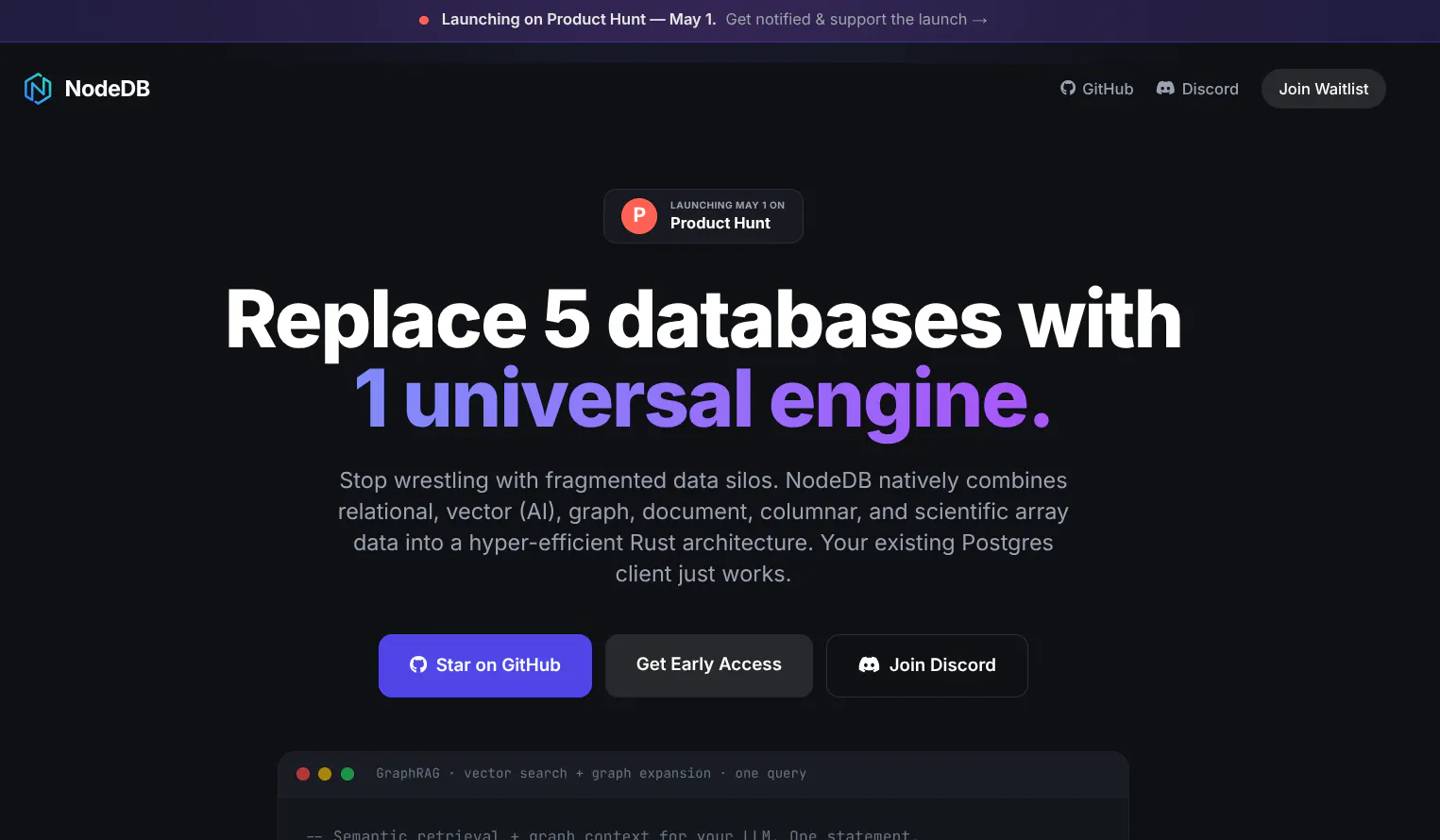
Replace 5 databases with
1 universal engine.
Your existing Postgres client just works.
Commercial cues
Model
subscription
Free tier
No
Trial
No
Pricing Strategy
- • Per-request pricing aligns costs directly with query volume and feature usage.
- • Monthly plans keep buying commitment low.
Operator context
Operating setup
Founded
May 2026
Platform
API
Audience
Developers
Social footprint
Tech stack
Builder Strategy
- Strategy Type
- Niche Specialist
- Stage
- Pre Revenue
- Effort
- Complex Stack
About NodeDB Expand
NodeDB targets developers building complex applications who are tired of managing fragmented data across multiple specialized databases. It provides a unified database engine that natively supports relational, vector, graph, and document data models.
This consolidation allows users to perform advanced queries, such as GraphRAG, directly within the database, eliminating the need for external orchestration and simplifying the application's data layer. Its positioning around a single, high-performance engine accessible via familiar Postgres clients reduces adoption friction and offers a alternative for modern AI-driven workloads.