A free, private calculator for estimating body fat percentage using multiple formulas.
Product memo
Individuals tracking body composition can estimate body fat percentage using multiple scientific formulas, all within the browser. It offers calculations from four validated methods, including CUN-BAE, U.S. Navy, BMI, and Jackson-Pollock, letting users select the well-suited fit for their available measurements. Calculations stay private and in-browser, serving those who prioritize data security over cloud storage.
For who
Individuals tracking body composition
Solves what
Estimates body fat percentage using multiple scientific formulas
- Multiple calculation methods
- Private, local browser calculations
- Body fat category and weight goals
In their own words
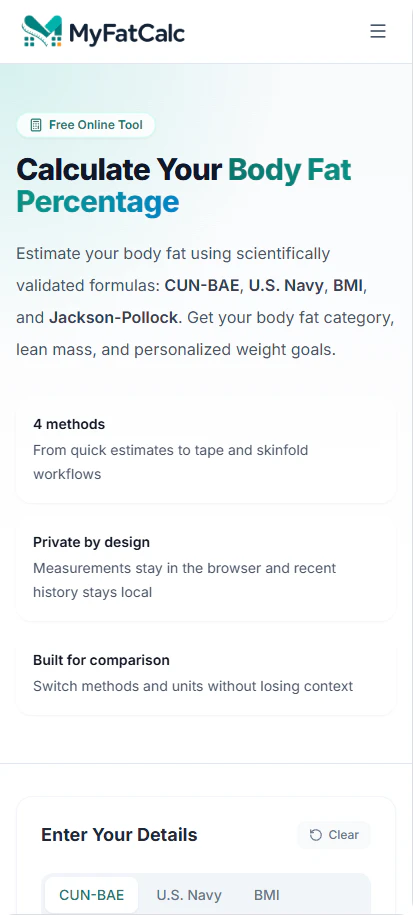
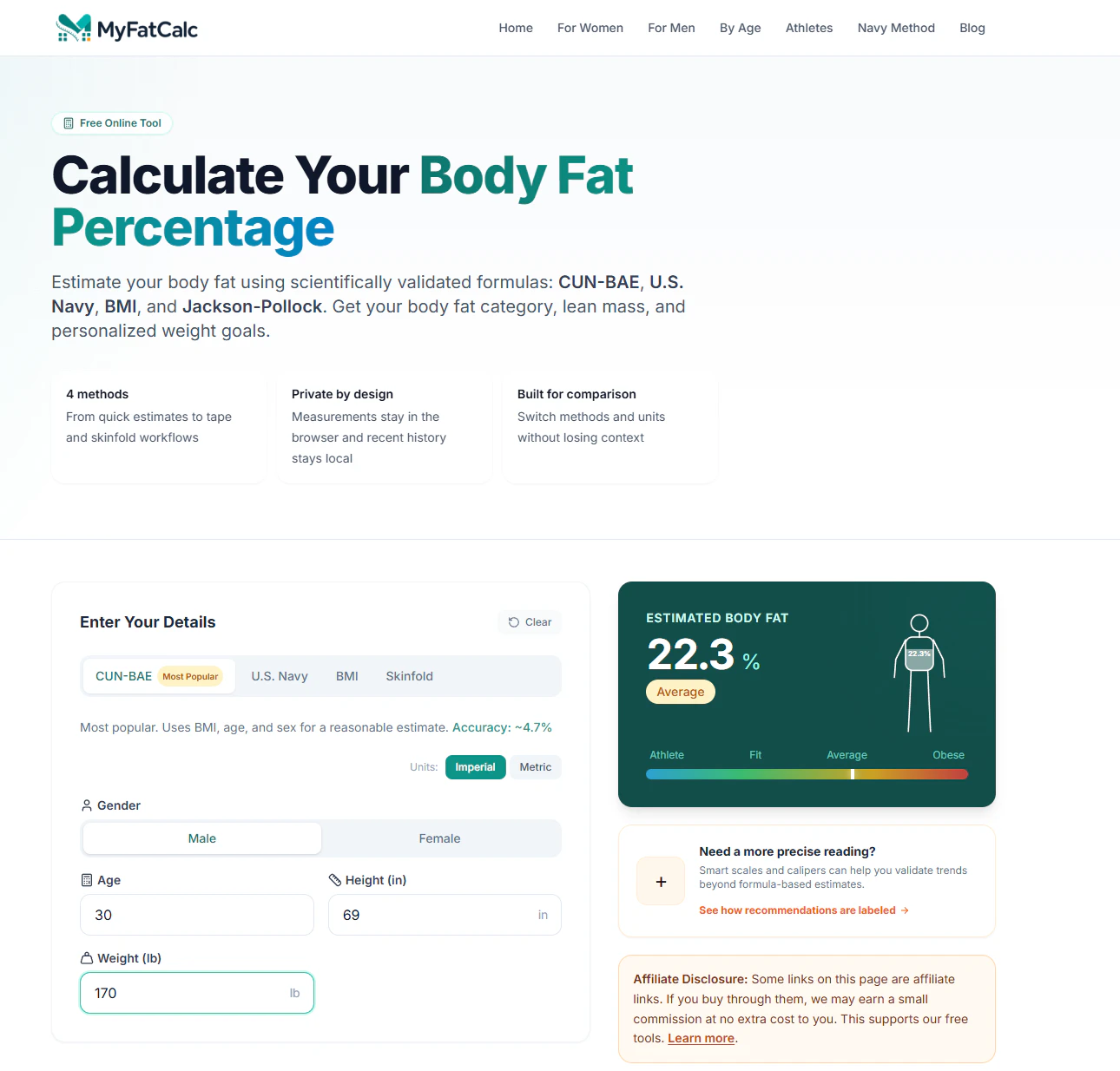
Calculate Your Body Fat Percentage
Estimate your body fat using scientifically validated formulas: CUN-BAE, U.S. Navy, BMI, and Jackson-Pollock.
Get your body fat category, lean mass, and personalized weight goals.
Commercial cues
Model
free only
Free tier
Yes
Trial
No
Pricing Strategy
This tool is completely free, offering a privacy-focused utility without any paid tiers or upgrades.
- • Privacy focus acts as a trust-building differentiator for health data.
- • No paid tiers means no upgrades strategy, simplifying user experience.
- • Free tier lowers testing friction.
Operator context
Operating setup
Founded
May 2026
HQ
United States
Platform
Web app
Audience
Consumers
Social footprint
Builder Strategy
- Strategy Type
- Niche Specialist
- Stage
- Pre Revenue
- Effort
- Solo Buildable
About Myfatcalc Expand
MyFatCalc provides a free, browser-based tool for individuals to estimate their body fat percentage. It serves users tracking body composition by offering calculations from four scientifically validated methods: CUN-BAE, U.S.
Navy, BMI, and Jackson-Pollock. This allows users to choose the most appropriate formula based on their available measurements.
The product's core positioning emphasizes privacy, with all calculations performed locally in the browser and data stored only on the user's device. This approach appeals to those who prefer to keep personal health data private and avoid sharing it with third-party services.