
A unified SDK for developers to store data across S3, R2, GCS, Azure, and more.
Product memo
Developers building applications with diverse storage needs use Files SDK to abstract away backend complexity. It provides a single, unified API for interacting with multiple object and blob storage providers, including S3, R2, GCS, and Azure. This approach simplifies development by allowing code to be written once and deployed across different backends, reducing vendor lock-in and simplifying integration for flexible storage products.
For who
Developers building applications with diverse storage backends
Solves what
Provides a single, unified SDK for interacting with multiple object and blob storage providers.
- Unified storage API
- Supports S3, R2, GCS, Azure, and more
- Web-standard I/O
In their own words
Write once. Store anywhere.
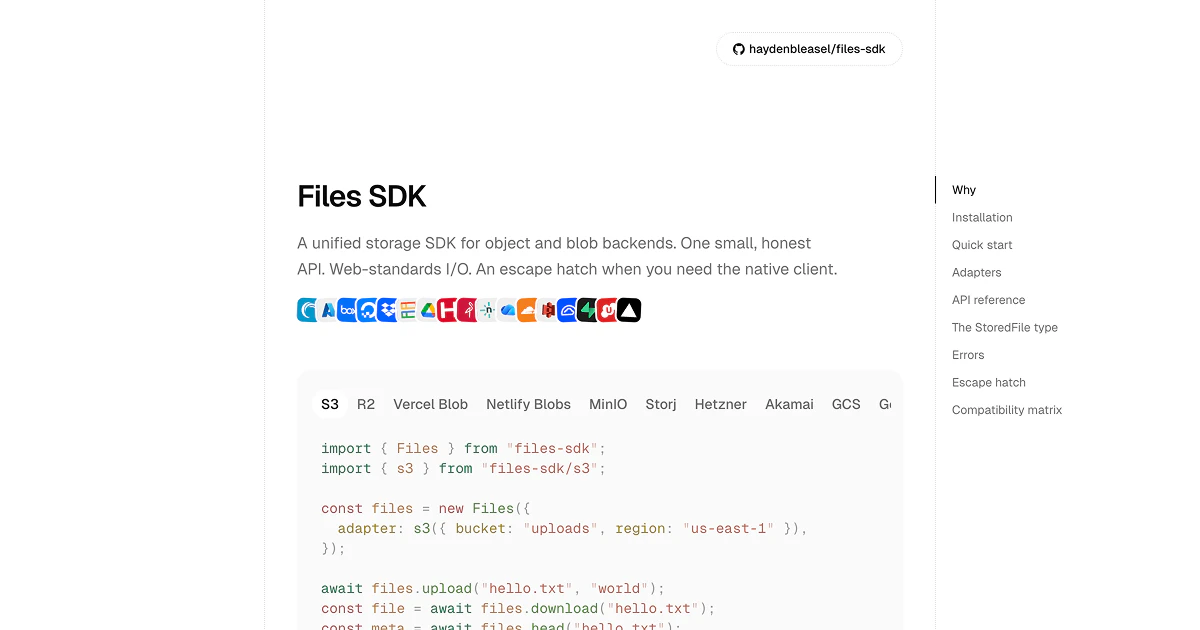
A unified SDK for S3, R2, GCS, Azure, and every other object or blob store. One small API, web standards, and an escape hatch when you need the native client.
Operator context
Operating setup
Team
Indie / lean
LLM classification
Founded
May 2026
Platform
API
Audience
Developers
Social footprint
Tech stack
Market demand
Files SDK keyword demand
5 keywords
Market demand is Starter-tier market intelligence.
Derived from this product’s latest SimilarWeb keyword mix — directional demand, not proof.
Builder Strategy
- Strategy Type
- Niche Specialist
- Stage
- Bootstrapped Lean
- Effort
- Solo Buildable
About Files SDK Expand
Files SDK provides a single, unified SDK for developers interacting with diverse storage backends such as S3, R2, GCS, and Azure. It simplifies application development by offering a consistent API, allowing code to be written once and deployed across various providers.
This open-source tool supports web-standard I/O and includes an escape hatch for native client interactions, reducing vendor lock-in and simplifying integration for flexible storage products. Its free model targets widespread developer adoption by solving a common infrastructure challenge.