
Generates video content from code and prompts for AI agents and developers.

Product memo
Developers and AI agents use Editframe to generate video content directly from code and prompts. It leverages declarative HTML and CSS for video composition, aligning with large language model training data. This approach allows agents to create video without needing proprietary APIs, offering a code-native workflow for automated video production.
For who
AI agents and developers
Solves what
Generating video content from code and prompts
- Declarative HTML/CSS video composition
- Agent integration via skills
- Browser, CLI, and cloud rendering
In their own words
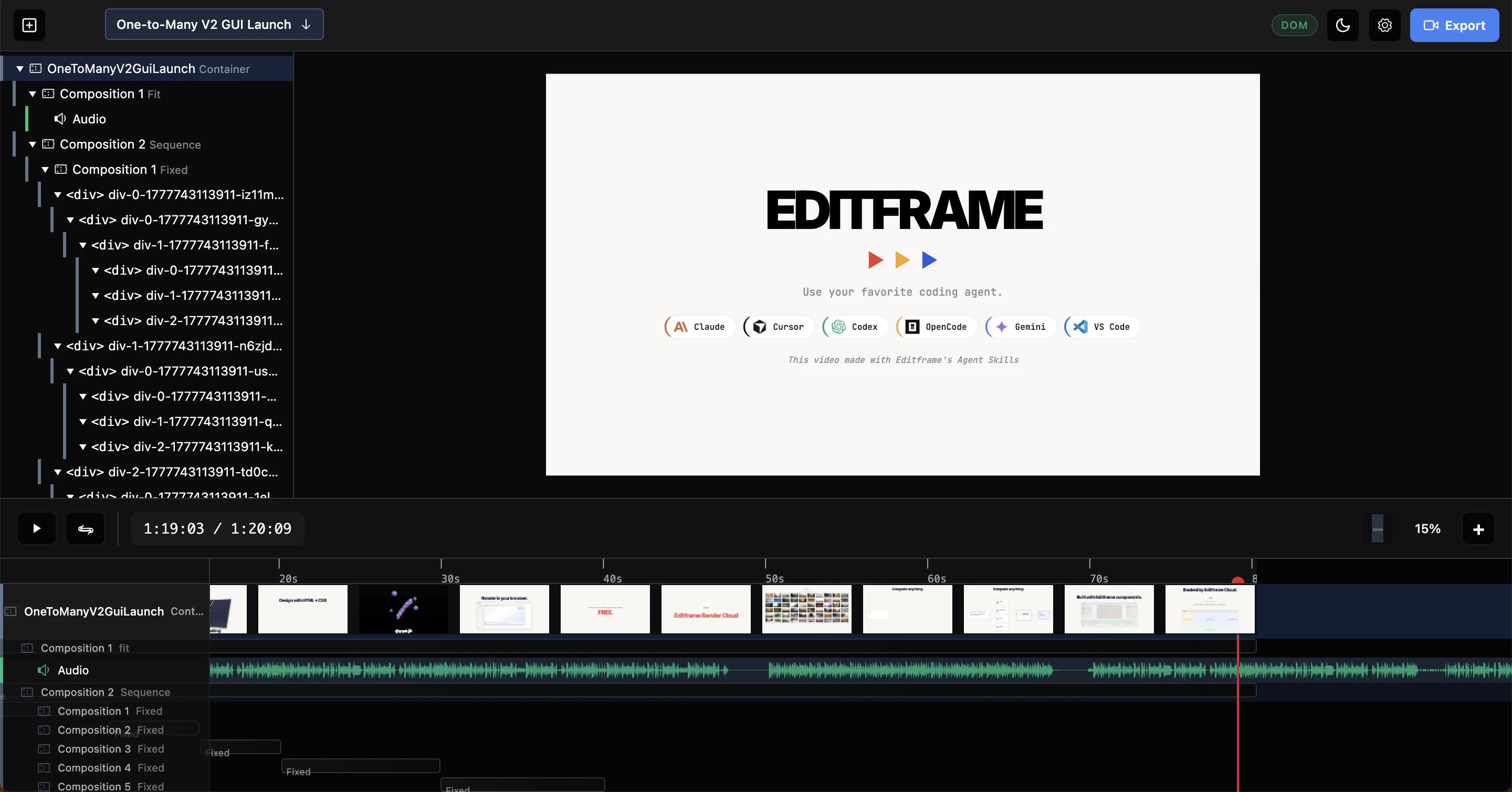
Hey, ClaudeCursorCodexCopilotGemini
Editframe lets your agent make videos.
Agents write declarative compositions as HTML + CSS — and can render in the browser, CLI, or cloud.
Commercial cues
Model
subscription
Free tier
Yes
Trial
No
Pricing Strategy
- • A free tier for small teams removes friction for initial adoption.
- • Usage-based rendering costs align pricing with actual resource consumption.
Operator context
Operating setup
Founded
May 2026
Platform
Web app
Audience
Developers
Social footprint
Market demand
Editframe Launch keyword demand
5 keywords
Market demand is Starter-tier market intelligence.
Derived from this product’s latest SimilarWeb keyword mix — directional demand, not proof.
Builder Strategy
- Strategy Type
- Niche Specialist
- Stage
- Vc Growth
- Effort
- Small Team
About Editframe Launch Expand
Editframe provides a platform for AI agents and developers to generate video content directly from code and prompts. It uses declarative HTML and CSS for video composition, which naturally aligns with the training data of large language models.
This allows agents to create video compositions without relying on proprietary APIs, offering a code-native workflow for automated video production. The platform supports rendering in the browser, CLI, or cloud, providing flexibility for various development environments.
Its hybrid pricing model includes tiered plans based on employee count and usage-based billing for rendering, catering to both small teams and larger organizations needing scalable cloud infrastructure.