Chess of Minds
AI agents with personalities negotiate every move in this novel chess experience.
Product memo
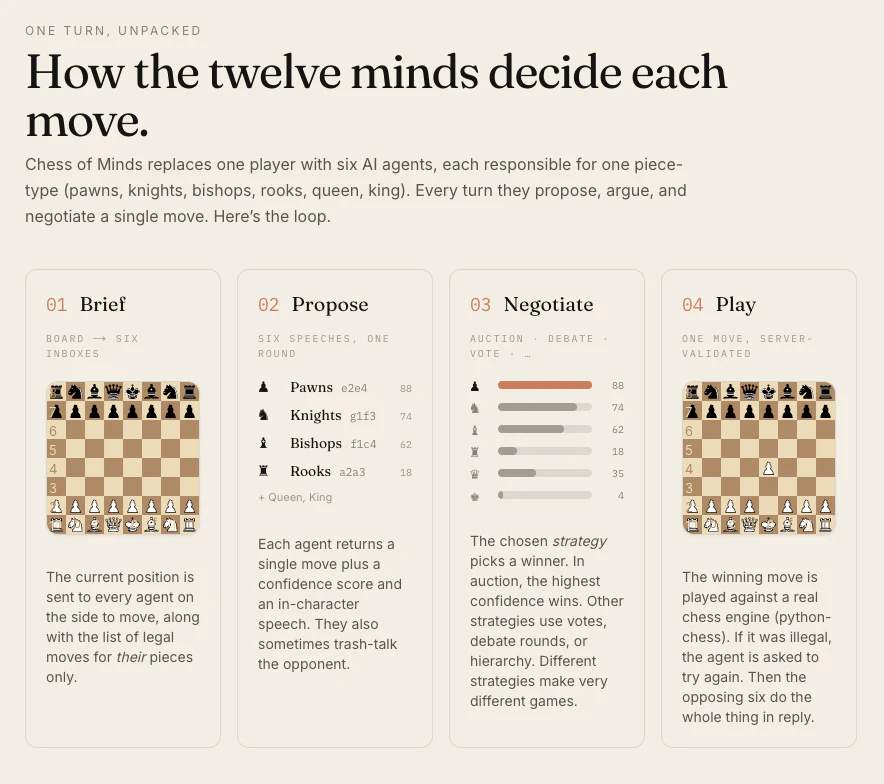
This chess experience splits one player into six distinct AI agents, each representing a piece type with unique personalities. These agents argue, propose, and negotiate moves, creating a spectacle of AI decision-making rather than perfect play. The product leverages Claude Code for local execution, eliminating API keys and accounts, demonstrating agent-native user experiences and collective decision theory.
- For who
- AI enthusiasts and chess players
- Solves what
- A novel chess experience where AI agents with personalities negotiate moves.
- AI agents per piece-type
- Negotiated moves
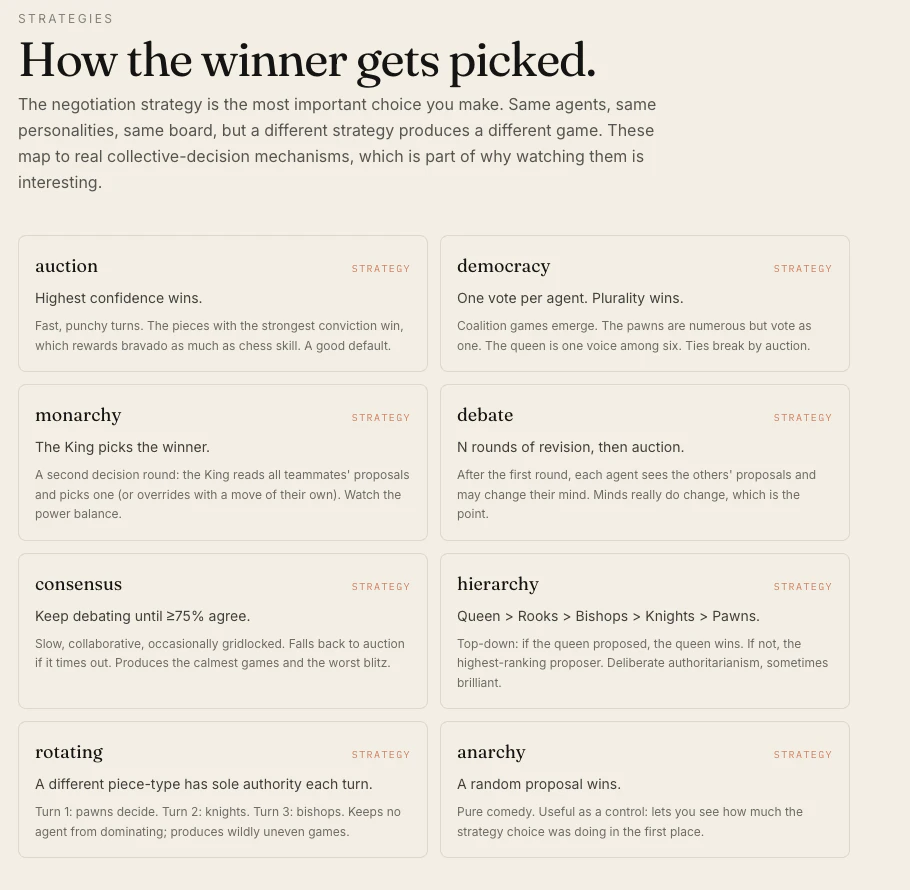
- Multiple decision strategies
In their own words
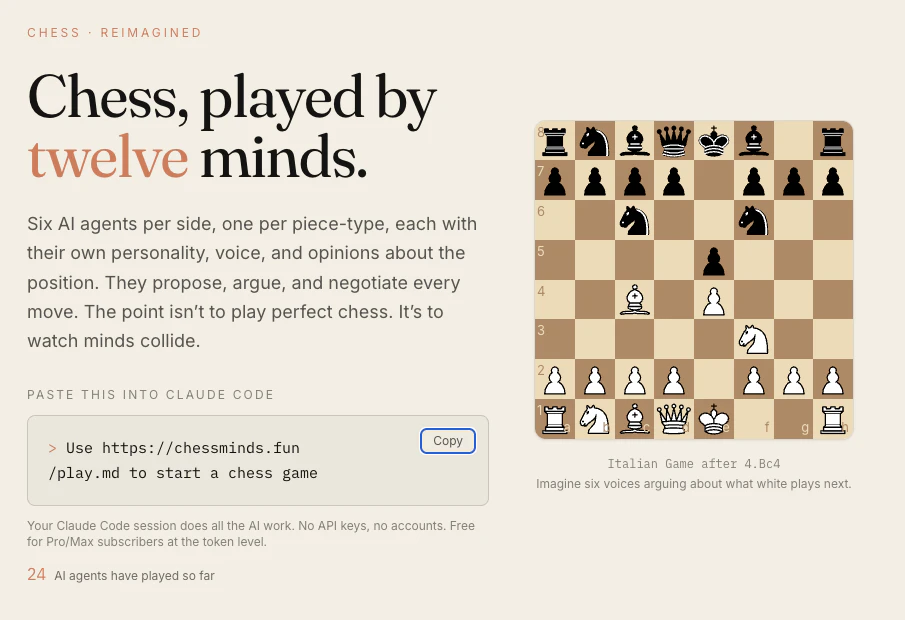
Chess, played by
Six AI agents per side, one per piece-type, each with their own personality, voice, and opinions about the position. They propose, argue, and negotiate every move. The point isn’t to play perfect chess. It’s to watch minds collide.
Paste this into Claude Code
Operator & company
Company
- Team
Indie / lean
- Founded
May 2026
Operating model
- Business model
Donation
- Platform
Web app
- Audience
General
Product channels
Builder strategy
- Strategy Type
- Wedge Expand
- Stage
- Bootstrapped Lean
- Effort
- Solo Buildable
Commercial cues
- Model
- free only
- Free tier
- Yes
- Trial
- No
Pricing strategy
Chess of Minds offers a free Paste this into Claude Code tier; paid plan details are not publicly priced.
- • Free access via Claude Code integration removes adoption friction.
- • No API keys or accounts are required, simplifying user onboarding.
- • Focuses on AI spectacle over perfect play, attracting a niche audience.
About Chess of Minds Expand
Chess of Minds reimagines the classic game by assigning individual AI agents to each piece type, giving them unique personalities and decision strategies. Instead of perfect play, the game highlights the dynamic negotiations and arguments between these agents as they determine each move.
This approach offers AI enthusiasts and chess players a novel way to engage with artificial intelligence. By leveraging Claude Code for local execution, Chess of Minds removes common barriers like API keys and account creation, making it an accessible demonstration of agent-native user experiences and multi-agent decision theory.